
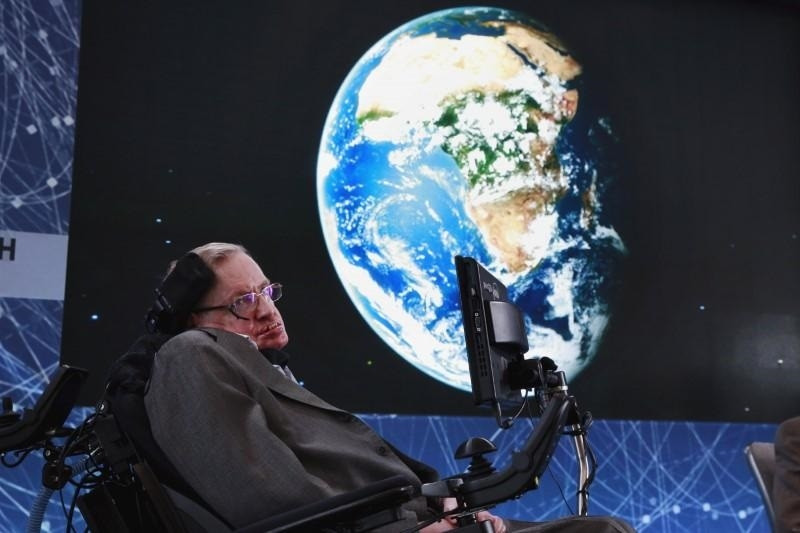
Stephen William Hawking (1942-2018) stands as one of the most brilliant and iconic scientific minds of the modern era. A theoretical physicist and cosmologist, his groundbreaking work on black holes, the origins of the universe, and the nature of space and time revolutionized our understanding of the cosmos. Yet, his extraordinary intellectual achievements were accomplished in the face of an increasingly debilitating motor neuron disease, which rendered him almost entirely paralyzed and dependent on a voice synthesizer for communication. His life was a testament to the indomitable power of the human spirit and intellect, inspiring millions worldwide.
Early Life and Academic Beginnings
Stephen Hawking was born on January 8, 1942, in Oxford, England, exactly 300 years after the death of Galileo Galilei. His parents, Frank and Isobel Hawking, were intellectually curious and somewhat eccentric. His father was a research biologist, and his mother was a philosopher and political activist. Even in his youth, Hawking displayed a keen curiosity about how things worked, though he wasn’t always a top student, often finding conventional schooling too slow.
He attended St Albans School in Hertfordshire and later, in 1959, went on to University College, Oxford, to study physics and chemistry. Despite finding the curriculum “ridiculously easy,” he excelled, particularly in physics. After graduating from Oxford with a first-class honors degree in natural sciences, he moved to Trinity Hall, Cambridge, in 1962, to pursue his Ph.D. in cosmology. This move would prove pivotal, as Cambridge was a hub for groundbreaking research in theoretical physics.
The Shadow of ALS: A Life Transformed

It was during his first year at Cambridge, in 1963, that Stephen Hawking’s life took an unexpected and tragic turn. At the age of 21, he was diagnosed with an early-onset, slow-progressing form of motor neuron disease, specifically amyotrophic lateral sclerosis (ALS), or Lou Gehrig’s disease. The prognosis was grim: doctors gave him only two to three years to live. This devastating news initially plunged him into despair, but it also spurred an intense focus on his work. He became determined to complete his Ph.D. thesis.
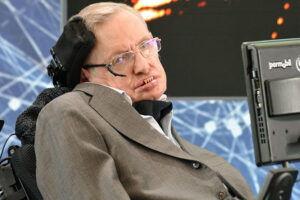
As the disease progressed, his physical abilities deteriorated. He gradually lost the use of his legs, then his arms, and eventually, in 1985, his voice after a tracheotomy following a bout of pneumonia. The loss of his voice was a profound blow, but a turning point came with the development of a speech-generating device, initially operated by hand and later by a single cheek muscle. This iconic voice synthesizer became synonymous with his public persona, allowing his brilliant mind to continue communicating with the world. Despite his severe physical limitations, Hawking never ceased his scientific research or his efforts to communicate complex ideas to a wider audience.
Groundbreaking Scientific Contributions
Stephen Hawking’s research fundamentally altered our understanding of gravity, black holes, and the very fabric of the universe.
1. Singularities and the Big Bang
His early work, particularly his Ph.D. thesis, focused on the properties of space-time singularities, points where the laws of physics break down, such as those found at the heart of black holes or at the origin of the universe. Collaborating with British mathematician Roger Penrose, Hawking developed the Penrose-Hawking singularity theorems in the late 1960s. These theorems demonstrated that, under certain general conditions, singularities are inevitable in both collapsing stars (forming black holes) and in the universe’s past, strongly supporting the Big Bang theory as the origin of the universe. This work was a crucial step in combining Einstein’s general relativity with the concept of a cosmic origin.
2. Black Hole Thermodynamics and Hawking Radiation
Hawking’s most revolutionary and famous contribution came in the early 1970s when he combined general relativity with quantum mechanics. Classical physics dictated that nothing, not even light, could escape a black hole once it crossed the event horizon. However, Hawking proposed that black holes are not entirely black. He theorized that due to quantum effects near the event horizon, black holes emit a faint thermal radiation, now famously known as Hawking radiation.
This discovery implied that black holes actually lose mass and energy over time and, given enough time, would eventually “evaporate.” This was a profound and controversial idea at the time, challenging the long-held belief that black holes were cosmic vacuum cleaners. Hawking radiation represented a crucial step towards a theory of quantum gravity, attempting to reconcile two of the most successful yet disparate theories in physics.
3. Cosmology and the “No-Boundary Proposal”
Hawking also made significant contributions to our understanding of the universe’s origin and evolution. With Jim Hartle, he proposed the “no-boundary proposal” for the universe. This theory suggests that the universe has no initial boundary condition in space-time, meaning it didn’t begin at a single point in time from which it expanded. Instead, it suggests a universe that is finite but unbounded, much like the surface of a sphere, which has no edge or beginning. This highly abstract concept aimed to address fundamental questions about what happened “before” the Big Bang, or if such a “before” even makes sense.
A Voice for Science: Popularizing Complex Ideas
Beyond his academic contributions, Stephen Hawking became a global icon for science communication. He possessed a rare gift for explaining complex scientific theories in an accessible way, bringing the wonders of cosmology and theoretical physics to a lay audience. His seminal 1988 book, “A Brief History of Time: From the Big Bang to Black Holes,” became an international bestseller, selling millions of copies and translating into numerous languages. The book explored fundamental questions about the universe’s origin, the nature of time, and the possibility of a unified theory of everything.
He followed this success with other popular science books, including “The Universe in a Nutshell” and “The Grand Design” (co-authored with Leonard Mlodinow). He also appeared in documentaries, television shows, and even guest-starred in The Simpsons and Star Trek: The Next Generation, further cementing his image as a pop culture figure and making physics cool. His ability to connect with the public, often using humor and wit delivered through his distinct voice synthesizer, transcended the traditional boundaries of academia.
Personal Life and Unyielding Resilience
Hawking’s personal life, particularly his battle with ALS, was an integral part of his public image. He defied the early prognosis by living for more than five decades with a progressive and devastating illness. His determination was remarkable. He married Jane Wilde in 1965, and they had three children: Robert, Lucy, and Timothy. Their story, marked by immense challenges and Jane’s extraordinary dedication, was famously depicted in the 2014 film The Theory of Everything. He later married his nurse, Elaine Mason, in 1995, though they divorced in 2006.
Despite his profound physical limitations, Hawking maintained a sharp intellect, a keen sense of humor, and an adventurous spirit. He traveled extensively, wrote prolifically, and continued to engage in scientific debate and public advocacy for disability rights. His life was a powerful testament to the triumph of the mind over matter and an enduring symbol of human resilience.
Enduring Legacy
Stephen Hawking passed away on March 14, 2018, at the age of 76, leaving behind an unparalleled scientific legacy. His work significantly advanced our understanding of the universe’s most mysterious phenomena, from the birth of time to the death of stars. His theoretical predictions, such as Hawking radiation, continue to inspire new avenues of research and remain a cornerstone of modern theoretical physics.
Beyond his scientific contributions, Hawking’s life inspired millions by demonstrating that profound physical disability does not equate to intellectual or spiritual limitation. He challenged perceptions of disability, showing that even with immense physical constraints, one could still explore the vastness of the cosmos and communicate profound ideas. His iconic voice, his determination, and his unwavering pursuit of knowledge will forever resonate, reminding humanity of its boundless potential. He left the world with a deeper understanding of its universe and an enduring message of hope and resilience.